

A land partnership with a contractor or developer is the route many owners take when they hold a well-located plot but do not want to sell it or carry the cost of building on it alone. Instead of remaining an idle asset, the land becomes a residential building or project in which you receive a number of units without paying a single pound toward construction.
Yet a deal that looks like a win for both sides can turn into a dispute lasting years if the land partnership agreement is drafted in a hurry. In most conflicts between owners and contractors, the problem is not the share itself but details that were never agreed at the outset. This guide explains how shares are calculated, which clauses the contract must include, and how to protect your rights until you receive your units.
If you are looking for a ready partner for your land, browse the real estate partnership opportunities listed on Nile Estate.

What Is a Land Partnership, and Who Benefits?
The idea is simple: the owner provides the land, while the contractor or developer covers licensing, construction, and finishing, and the resulting units are divided between them in an agreed ratio. In most cases neither party pays the other in cash; they share the output instead.
The owner benefits by receiving units worth far more than the land alone, which can be lived in, rented out, or sold. The contractor or developer benefits by starting a project without paying for the land upfront, so all available cash goes into construction. That is why this model is widespread in Egypt's new cities and in neighborhoods where land prices are high.
How Is the Owner–Contractor Share Calculated?
There is no fixed ratio that fits every plot; each deal is assessed on its own terms. At its core, the calculation compares the value each side brings: the land on one side, and the cost of construction, finishing, and permits on the other.
The main factors that raise or lower the owner's share:
- Location: Land in a high-demand area gives the owner stronger negotiating power.
- Permitted height and building ratio: The more floors and built-up area allowed, the more units there are to divide.
- Finishing level: Premium finishing raises the contractor's cost, which is usually reflected in a larger share.
- Who pays for permits and utilities: Settling this early changes the entire calculation.
- Type of units: Ground-floor retail units raise the project's value and need a specific agreement on who owns them.
Our practical advice: never accept a ratio before asking for an estimate of construction costs and expected sale prices in the area, because that is what tells you whether the offer is fair.
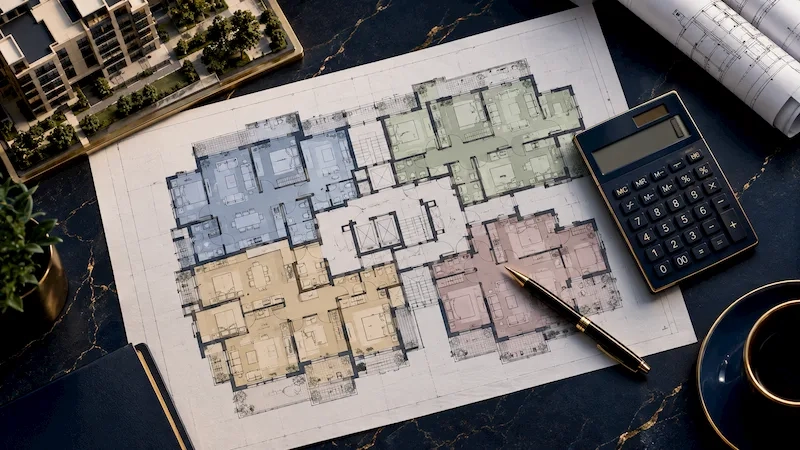
Key Clauses in a Land Partnership Agreement with a Contractor
A good contract answers in advance every question that could cause a dispute later. No agreement should be missing these clauses, whether your partner is a contractor or a developer:
Identifying units by floor and orientation
Do not settle for a percentage. Specify in the contract the exact unit numbers that will be yours, on which floor, and with which orientation and frontage. A 50% share of a building might mean the upper floors facing the street, or it might mean the rear units, and the price gap between the two is significant.
Timeline and delay penalties
Set a clear start date and a handover date, with interim milestones such as completing the concrete structure and then the finishing. Add a defined penalty for every month of delay beyond the deadline, since it is the strongest incentive for a contractor to stay on schedule.
Finishing level and specifications
A phrase like "super deluxe finishing" is not enough on its own, because each side may read it differently. Attach a technical schedule specifying flooring, doors, windows, sanitary fittings, and electrical work, and state that the owner's units must match the contractor's units in specification.
Building permit and liability for violations
State who obtains the building permit and who pays its fees, and make it explicit that the contractor is liable for any violation committed during construction, including exceeding the permitted height or altering the plans without approval.
Taxes and utilities
Clarify who pays the real estate disposal tax when each party sells its units, and who covers the cost of connecting water, electricity, gas, and individual meters. Leaving these points open is one of the most common causes of disputes after handover.

Guarantees That Protect the Landowner
The biggest risk an owner faces is the contractor or developer stopping halfway, after the land has effectively left the owner's hands. Ask for real guarantees before you sign:
- A limited power of attorney, not a general one: If the contractor needs a power of attorney to obtain the permit or sell its share, limit it to those purposes and to its own share, never a general authority over the land.
- Link the contractor's sales to progress: Require that the contractor may not start selling its units until a defined construction stage is reached, so it cannot collect buyers' money and then stall.
- A bank guarantee or security cheques: Some owners ask for financial security covering part of the land's value, returned at handover.
- A clear termination clause: Give the owner the right to terminate the contract and recover the land if work stops for a set period without an acceptable reason.
- Phased handover: Receive your units first, or at the same time as the contractor's, never after them.
In every case, do not sign any partnership agreement before a lawyer specializing in real estate contracts has reviewed it, because the wording of a single clause can decide your entire share.
Mistakes That Cost Landowners Their Rights
- Choosing a contractor on the highest share alone: The most generous offer from a contractor with no track record may be the riskiest for you. Ask to visit projects they have delivered and speak to those owners about their experience.
- Signing a ready-made template: Many contractors present a contract written in their favor, and you are fully entitled to amend it before signing.
- Not registering the contract or certifying its date: An uncertified contract weakens your position if the contractor sells or transfers the land to a third party.
- Leaving units unassigned until handover: This lets the contractor pick the best units and leave you the rest.
- Not supervising construction: Having your own consulting engineer review the work at each stage saves you many surprises.
Partnering with a Contractor or a Real Estate Developer?
| Criterion | Individual contractor | Real estate developer |
|---|---|---|
| Suitable project size | A single building or small block | A large plot or multi-building project |
| Owner's negotiating power | Usually higher | Lower, with more standardized terms |
| Financial strength and ability to finish | Varies widely between contractors | Usually higher with established companies |
| Construction speed | Can be faster on small projects | Tied to the company's plan and sales phases |
| Unit value after handover | Depends on area and finishing | May rise thanks to the developer's name and project amenities |
The right choice depends on the size and location of your land. A small plot inside a residential neighborhood usually suits a partnership with a trusted contractor, while a large plot in a new city may achieve a higher value with a developer that has a name in the market.
Partnership, Sale, or Swap?
If you need cash quickly, selling is the clearest option. If you want a ready asset in another area without waiting for construction, a swap may suit you better; browse properties for swap to see what is available. A partnership is the best fit for owners who can wait out the construction period in exchange for a value well above the land's current price.
To assess the partnership precisely, compare the expected value of your units at handover with the land's sale price today, factoring in the waiting period. To see how partnership compares with other options such as rented properties, serviced apartments, and auctions, read our guide to the best real estate investment in Egypt.
Partnership Opportunities Available Now
The nileestate.com team helps landowners reach trusted contractors and developers, and supports them through share negotiations and contract review. Developers looking for land to partner on can also find ready offers among our real estate partnership opportunities. Message us on WhatsApp to list your land or find the right partner for a land partnership with a contractor or developer on fair terms.
Frequently Asked Questions
Who pays the taxes in a partnership agreement?
The contract decides this, and the common arrangement is that each party pays the taxes on the units it sells from its own share. What matters is that this clause is written explicitly rather than left to custom.
What happens if the contractor stops work?
It depends on the contract. If it includes a clear termination clause and delay penalties, the owner can claim them, or terminate the agreement and complete construction with another contractor. A contract without these clauses leaves the owner facing a long court dispute.
Can I partner on agricultural land?
Egyptian law prohibits building on agricultural land except in permitted cases within the approved urban boundary and with official permits. Check the land's legal status before any agreement, because unlicensed construction can expose both parties to demolition and penalties.
Do I need to register the partnership agreement?
At a minimum, it is advisable to certify the contract's date or have it notarized, as this protects your rights if a third party later claims to have bought the land or some of the units. Ask your lawyer which option suits your case best.