
Many people buy property because they believe real estate is a safe investment. In many cases, that is true. But safety alone is not enough. A good property investment is not only an asset that may rise in value over time. It is also an asset that can produce income, attract tenants, preserve value, and remain liquid enough to sell when needed.
This is why one question matters so much:
How do you calculate rental yield?
This question is important for landlords who want to know whether their rent is fair. It matters to investors comparing an apartment, shop, office, clinic, or serviced unit. It matters to real estate brokers who want to advise clients properly. It also matters to developers who need to understand whether their product is attractive to income-focused buyers.
Rental yield is not just the monthly rent. Monthly rent is only the starting point. A serious calculation begins with annual rental income, then moves to vacancy, operating expenses, net operating income, and finally compares that income to the property value or to the actual cash invested.
What Does Rental Yield Mean?

Rental yield is the percentage that shows how much rental income a property generates compared to its value or purchase cost.
In simple words, if you buy a property for a certain amount, how much of that amount comes back to you every year through rent?
For example, if you buy an apartment for EGP 10,000,000 and rent it for EGP 50,000 per month, the annual rent is EGP 600,000.
To calculate the basic rental yield, you divide the annual rent by the property value.
The first formula is:
Gross Rental Yield = Annual Rent ÷ Property Value × 100
In this example:
600,000 ÷ 10,000,000 × 100 = 6%
So the gross rental yield is 6% per year.
But is this the real return? Not exactly. This number does not include expenses.
Gross Yield vs Net Yield
There is a very important difference between gross rental yield and net rental yield.
Gross yield calculates income before expenses. It is useful for a quick first comparison between properties.
Net yield is more accurate because it shows what is left after deducting the costs of owning and operating the property.
Gross yield tells you how much the property brings in before deductions.
Net yield tells you how much you actually keep.
The gap between the two can be significant.
A property rented for EGP 50,000 per month may look excellent. But if service charges, maintenance, management fees, repairs, taxes, and vacancy periods are high, the real return can be much lower.
Step One: Calculate Annual Rent
The simplest calculation is:
Annual Rent = Monthly Rent × 12
If the monthly rent is EGP 40,000:
40,000 × 12 = EGP 480,000 per year
But in a proper investment analysis, we should not always assume the property will be rented for all 12 months. There may be a gap between tenants. A tenant may delay payment. The unit may need repairs before being rented again.
This is why investors often deduct a vacancy allowance.
For example, if you assume the property may be vacant for one month every year, the vacancy allowance is about 8.3% of the year.
In this case:
Theoretical annual rent = EGP 480,000
Vacancy deduction = EGP 40,000
Expected effective annual rent = EGP 440,000
This is more realistic than simply multiplying the monthly rent by 12.
Step Two: Deduct Operating Expenses
To calculate net yield, you must deduct property-related expenses. These may include:
- Annual maintenance costs
- Compound or homeowners association fees
- Property management fees
- Brokerage fees when finding or renewing tenants
- Regular repairs
- Insurance, if applicable
- Taxes and government charges
- Vacancy periods
- Furniture cost for furnished units
- Depreciation of furniture and appliances
Many landlords make the mistake of calculating rental return without deducting these items. That makes the return look higher than it really is.
Net Operating Income
In real estate investment, one of the most important concepts is Net Operating Income, known as NOI.
The formula is simple:
Net Operating Income = Effective Rental Income + Other Income − Operating Expenses
Other income may include parking rent, storage rent, advertising income, or service-related income in certain types of properties.
One important point: NOI does not deduct loan installments or mortgage interest. It measures the performance of the property itself, not how the purchase was financed.
Example:
An apartment rents for EGP 50,000 per month.
Annual rent = EGP 600,000
Assume one vacant month = EGP 50,000
Effective rental income = EGP 550,000
Operating expenses, maintenance, and repairs = EGP 70,000 per year
NOI = 550,000 − 70,000 = EGP 480,000
This is the number you should use when evaluating the property as an income-producing asset.
Net Rental Yield
After calculating NOI, you can calculate net rental yield:
Net Rental Yield = NOI ÷ Total Property Cost × 100
Total property cost should not include only the purchase price. It is better to include all costs paid to make the property ready for rent.
For example:
Purchase price = EGP 10,000,000
Finishing and furnishing = EGP 800,000
Brokerage, legal, and other transaction costs = EGP 200,000
Total cost = EGP 11,000,000
If NOI = EGP 480,000:
Net Rental Yield = 480,000 ÷ 11,000,000 × 100 = 4.36%
In this case, the gross yield may appear to be around 6%, but the true net yield is closer to 4.36%.
That is the difference between a quick calculation and a serious investment calculation.
Capitalization Rate
The capitalization rate, or cap rate, is one of the most widely used tools for evaluating income-producing properties, especially retail units, offices, clinics, buildings, and commercial assets.
The formula is:
Cap Rate = Net Operating Income ÷ Property Value × 100
If a commercial property generates EGP 1,200,000 in annual NOI and its market value is EGP 20,000,000:
1,200,000 ÷ 20,000,000 × 100 = 6%
The cap rate is 6%.
This number helps investors compare one income-producing property with another. If two properties are in the same market and have similar risk, and one offers a 6% cap rate while the other offers 8%, the second may look more attractive.
But a higher cap rate is not always better. It may indicate higher risk, a weaker tenant, a less attractive location, an older building, or greater difficulty in re-leasing the property.
A cap rate must always be read together with location quality, tenant strength, lease length, property condition, and future demand.
Cash-on-Cash Return
Cash-on-cash return is very useful when the buyer uses financing, installments, or pays only part of the total property value upfront.
This metric does not compare income to the full property value. It compares annual cash flow to the actual cash the investor has paid.
The formula is:
Cash-on-Cash Return = Annual Pre-Tax Cash Flow ÷ Total Cash Invested × 100
Example:
Property value = EGP 10,000,000
Cash paid as down payment and transaction costs = EGP 3,000,000
NOI = EGP 600,000 per year
Annual debt service or installments = EGP 300,000
Annual cash flow = 600,000 − 300,000 = EGP 300,000
Cash-on-Cash Return = 300,000 ÷ 3,000,000 × 100 = 10%
In this case, the property may have a 6% net yield on total value, but the investor’s cash-on-cash return is 10% because only part of the property value was paid in cash.
This metric is useful for investors who want to understand the return on their actual liquidity.
Payback Period
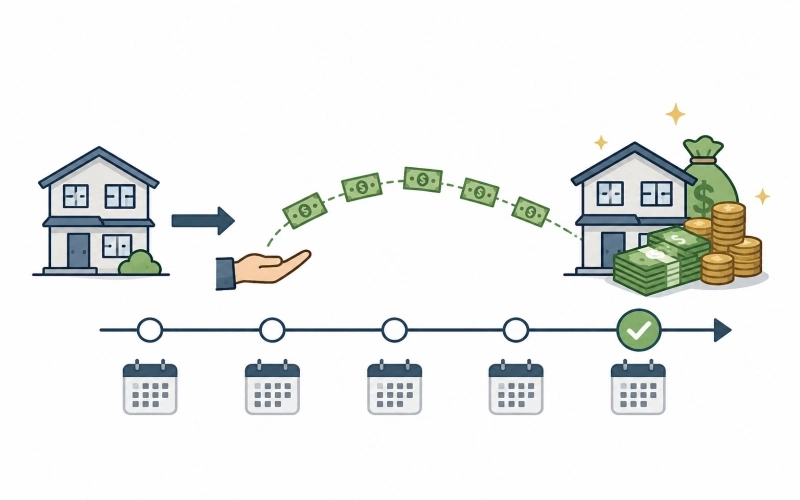
Some investors prefer one simple question: How many years will it take to recover the property cost from net rent?
The formula is:
Payback Period = Total Property Cost ÷ Annual Net Income
Example:
Total property cost = EGP 10,000,000
Annual net income = EGP 500,000
Payback period = 10,000,000 ÷ 500,000 = 20 years
This means it would take 20 years to recover the property cost from net rental income alone, without considering capital appreciation, inflation, or resale value.
This metric is not enough on its own, but it is easy to understand and useful for comparison.
Higher Yield Does Not Always Mean a Better Property
One of the most common mistakes is choosing the property with the highest rental yield only.
That can be dangerous.
A property in a weaker location may offer a 10% yield, but it may be difficult to rent, have unstable tenants, require frequent maintenance, or show limited capital growth.
Another property in a prime location may offer only 4% yield, but it may preserve value, appreciate over time, and remain easy to sell.
This is why investors must separate two types of return:
Rental return, which comes from annual rent.
Capital return, which comes from the increase in property value over time.
The best investment is often not the one with the highest rent. It is the one that balances income, safety, growth potential, tenant quality, and exit liquidity.
A Complete Example
Let us assume an apartment in New Cairo:
Purchase price = EGP 12,000,000
Finishing and furnishing = EGP 1,000,000
Brokerage, legal, and setup costs = EGP 300,000
Total cost = EGP 13,300,000
Expected monthly rent = EGP 70,000
Theoretical annual rent = EGP 840,000
Assume one vacant month = EGP 70,000
Effective annual rent = EGP 770,000
Operating expenses, maintenance, and repairs = EGP 120,000
NOI = 770,000 − 120,000 = EGP 650,000
Gross Yield = 840,000 ÷ 13,300,000 × 100 = 6.31%
Net Yield = 650,000 ÷ 13,300,000 × 100 = 4.88%
Payback Period = 13,300,000 ÷ 650,000 = 20.46 years
This gives a clearer picture. The important point is not only that the apartment rents for EGP 70,000 per month. The more important question is how much remains after costs, and what that amount represents compared to the total capital invested.
How Brokers Can Use These Calculations
A professional real estate broker should not only tell a client, “This is a great opportunity.”
A better approach is to present the numbers:
- Purchase price
- Expected rent
- Gross yield
- Expected expenses
- Net yield
- Tenant demand
- Re-rental potential
- Area strength
- Capital appreciation potential
- Possible risks
This turns the broker from a messenger of listings into a true advisor.
How Developers Can Use Rental Yield
Developers also need to understand rental yield, especially when selling investment units, commercial units, offices, clinics, serviced apartments, or income-generating products.
The clearer the expected rental return, the easier it becomes to market the property to investors.
But developers should be realistic. Overstated yields may help early sales, but they damage trust later. A better approach is to present three scenarios: conservative yield, average yield, and optimistic yield.
Conclusion
Calculating rental yield is not complicated, but it must be done in the right order.
- Start with annual rent.
- Calculate gross yield.
- Deduct vacancy and operating expenses.
- Calculate NOI.
- Calculate net yield.
- Use cap rate to compare income-producing properties.
- Use cash-on-cash return if the purchase involves financing or installments.
And remember: yield is important, but it is not the whole decision.
A good rental property combines reasonable income, strong location, reliable tenants, manageable expenses, capital growth potential, and easy resale.
Through NileEstate, landlords, investors, brokers, and developers can compare income-generating properties and rental opportunities with a clearer view of the numbers behind the decision.